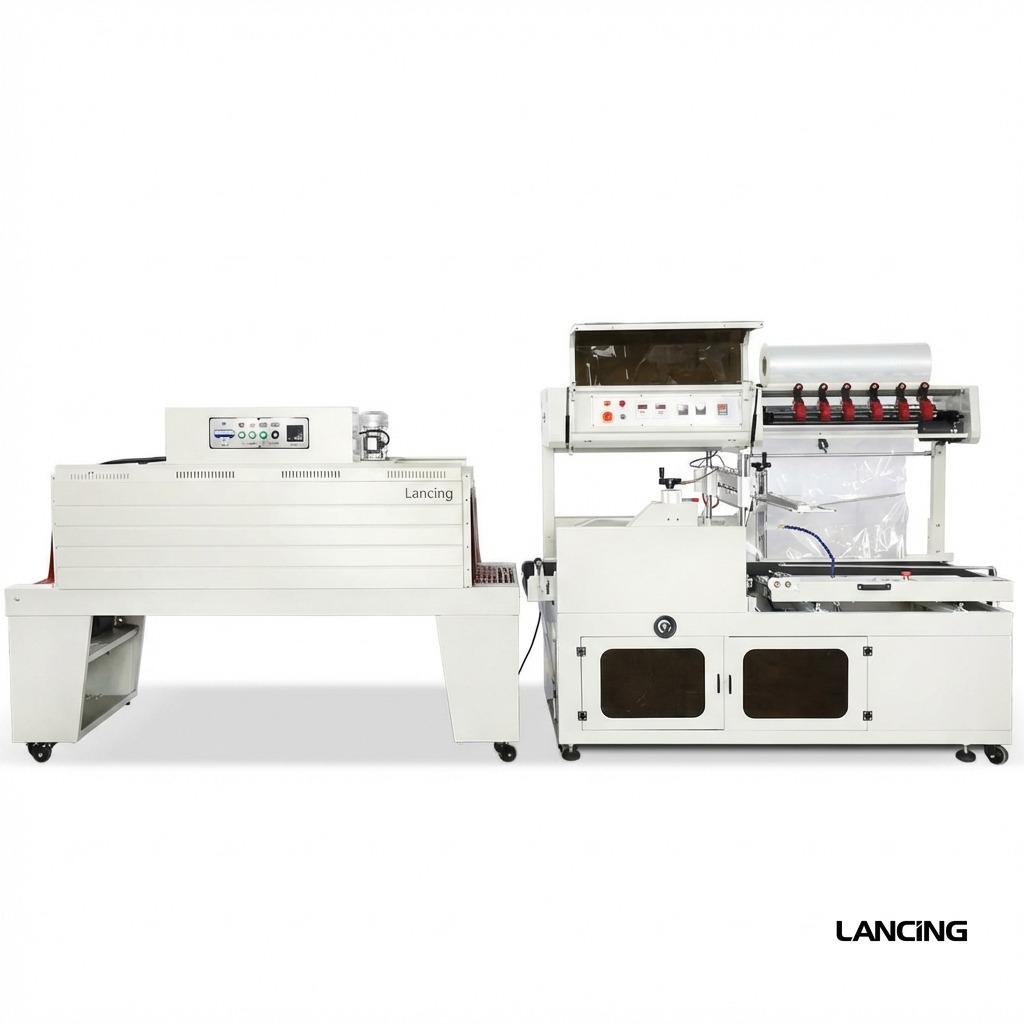
Follow the product from centre-folded film through the L-shaped seal, shrink tunnel and cooling stage, with practical checks for a reliable finished pack.
An L sealer forms a film pocket, closes it and then shrinks it around the product
Direct answer: An L sealer feeds a product between the two layers of centre-folded film, closes an L-shaped heated wire or blade around the open sides, cuts and seals the film, and then transfers the closed pack to a shrink tunnel. Hot air recovers the film around the product, while the discharge and cooling stage stabilise the finished pack.
The sealer and tunnel perform different jobs. The sealing frame must create a continuous closed pocket with enough film in the right position. The tunnel can then shrink that film, but it cannot repair a missing, contaminated or badly positioned seal. Pack quality therefore depends on the whole route rather than one temperature or speed setting.
Film presentation: centre-folded film opens into an upper and lower web around the forming area.
Product loading: the product is placed or conveyed between the film layers in the agreed orientation.
Film measurement: the machine or operator draws enough film around the pack for the seal and shrink allowance.
L-shaped sealing: the frame closes the open side and trailing edge, separating the finished film pocket from the remaining web.
Tunnel shrinking: controlled hot air, conveyor movement and dwell time recover the film around the product.
Cooling and handling: the pack stabilises before it is turned, accumulated, labelled, inspected or packed into an outer case.
First-party Lancing video showing a product being placed in centre-folded film, sealed and transferred through a heat-shrink tunnel.
Visual transcript: an operator positions a small carton between the film layers on a chamber-style L-sealing station, the L-shaped frame closes around the film, and the sealed pack moves through the illuminated heat-shrink chamber on a roller conveyor. The clip demonstrates the sequence; it does not establish a universal speed or suitability for every product.
Process stage
What it controls
Evidence to review
Film feed
Film position, tension and material available around the pack.
Roll specification, centre-fold width and tracking during a sample run.
Seal cycle
Closure of the film pocket and position of the seam.
Unshrunk seal continuity, contamination and film folds.
Shrink tunnel
Film recovery around faces, corners and underside.
Airflow, dwell time, temperature and conveyor contact.
Cooling
Final shape, film stability and readiness for handling.
Cooled samples after the normal discharge and accumulation sequence.
What happens between the film roll and the finished pack?
Direct answer: The film is opened, formed around the product, sealed into a closed pocket, shrunk and then cooled before normal handling.
Each step changes the result. Film width and tracking affect the available material; the seal closes the pocket; perforation helps trapped air escape; tunnel conditions recover the film; and cooling determines how the pack behaves when it reaches the next process.
Why does the L-shaped frame create two seal edges in one cycle?
Direct answer: The frame closes the side and trailing edge of centre-folded film while the fold itself provides the other closed side.
This geometry creates a film pocket around an individual or grouped product without making four separate seals. The exact seal position and film allowance still depend on the product orientation and the machine configuration.
Why is film perforation used before the shrink tunnel?
Direct answer: Perforation provides controlled paths for air to leave the film pocket as the film contracts.
Without suitable air evacuation, the film can balloon, trap pockets or resist recovery around corners. Too much or poorly positioned perforation can also affect appearance or protection, so the perforation arrangement should be checked with the actual film and pack.
Which part of the process should be proved with sample packs?
Direct answer: The complete sequence should be proved, from product presentation and sealing through tunnel shrinking, cooling and downstream handling.
Testing only the sealing frame does not prove the finish, while testing only a tunnel does not prove the film pocket or product spacing. Representative samples should include the difficult product variants and the intended film.
Scope note: This page explains the general process. Final machine suitability, guarding, utilities and settings must be confirmed for the actual product, film, line and site risk assessment.