Semi-automatic L sealers
Suitable for lower-volume wrapping, product trials, seasonal packs and operations where an operator loads and controls each cycle.
- Lower initial footprint
- Good for mixed products
- Operator-dependent output
L-sealer routes for cartons, bundles and presentation shrink wrapping.
Compare routes
Choose the route based on output, changeover needs and how consistently the pack arrives to the sealing area.
Suitable for lower-volume wrapping, product trials, seasonal packs and operations where an operator loads and controls each cycle.
Designed for repeatable output and more consistent film handling where products can be spaced and fed through the sealing zone automatically.
An integrated route where sealing and heat shrinking are considered together, helping match seal quality, tunnel heat and conveyor speed.
Product range
Use this page as the product hub for L-sealer and related shrink wrapping machinery. Each route can be quoted against your pack dimensions, film type and target output.

Compact chamber shrink wrapping for small boxes, kits and retail items.
View product range →
Automatic film folding, L-sealing and cutting for repeat production.
View product range →
Shrink sleeve sealing for trays, multipacks, bottles and grouped cartons.
View product range →
Controlled heat-shrink tunnels matched to film, pack dimensions and speed.
View product range →
Applicators for shrink sleeve labelling and tamper-evident sleeve work.
View product range →
Horizontal wrapping routes for individual packs, bars, bakery and similar products.
View product range →Featured machine
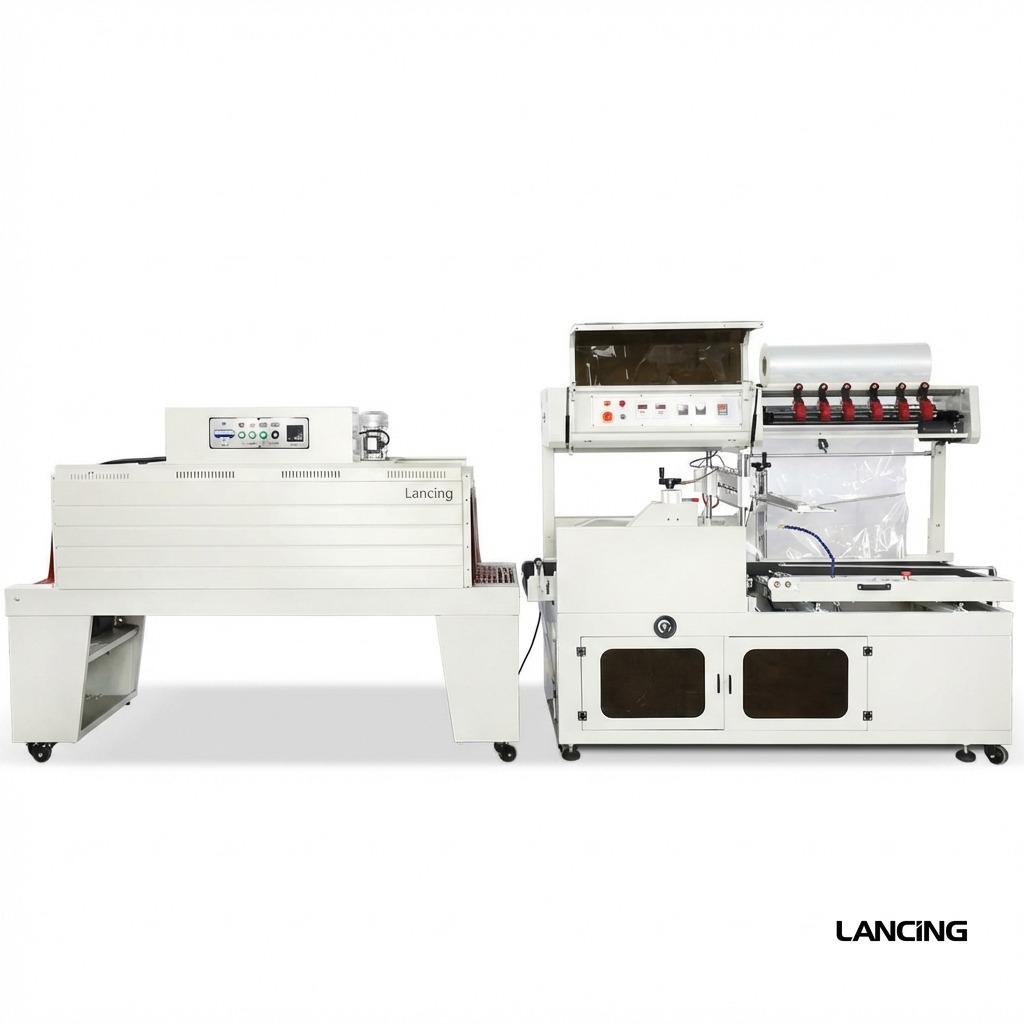
The LU-SPL6 route is now listed under the Machines page instead of as a separate top-menu item. It combines automatic sealing with a heat tunnel for POF and PE shrink wrapping work where repeatable presentation packs are required.

Selection checklist
A stronger specification starts with the real product and pack data. Send the following with your enquiry so the machine can be matched to the work rather than quoted from a generic assumption.
Comparison
| Requirement | Best route to consider | Why it matters |
|---|---|---|
| Low batches / trials | Semi-automatic L sealer | Flexible and lower-cost when speed is not the bottleneck. |
| Defined products at repeatable output | Automatic L sealer | Improves consistency and reduces operator handling. |
| Finished presentation shrink pack | L sealer plus heat tunnel | Sealing and shrink finish must be balanced together. |
| Long or highly variable product lengths | Side sealer review | Some products may be better served by continuous side sealing. |
Support
Lancing UK can support the complete enquiry route: checking product fit, advising on practical line layout, confirming utilities and supporting the machine after supply.
We check product dimensions, film type, output target, pack stability and shrink finish requirements before recommending an L-sealer route.
Advice can include infeed height, operator access, conveyor direction, tunnel position, outfeed space and connection to wider packing lines.
We help confirm practical requirements such as machine footprint, power, compressed air where needed, access, commissioning and operator training.
After supply, Lancing UK can support parts identification, service advice, consumables guidance and technical assistance for ongoing production use.
FAQs
Start with pack dimensions, product stability, film type, target output, seal appearance, heat tunnel requirements and the space available for infeed and outfeed.
Automatic L-sealers are usually better for repeatable higher-volume work. Manual and semi-automatic options can still be suitable for lower output, trials or small-batch projects.
Yes. L-sealers can be integrated with conveyors, heat tunnels, coding, labelling, carton packing or other end-of-line equipment depending on the line layout.
Common buyer searches
These pages answer the main buying questions that usually come before an L-sealer quotation.
For carton and retail pack lines that need a complete sealing and shrink tunnel route.
Understand the specification details that change machine cost and layout.
Compare L sealers, chamber sealers, sleeve sealers and heat tunnels.
Machine comparison
The best L-sealer route depends on product size, film, available labour and how the pack leaves the machine. A semi-automatic route can work well for short runs where an operator places each item and controls the pace. An automatic L sealer is normally considered when products arrive from a conveyor or where repeatable output and line integration are more important.
The heat tunnel should be selected with the sealer. Tunnel belt speed, chamber length, airflow and cooling influence film recovery and can expose problems such as trapped air, dog-ears, weak seals or poor presentation. Lancing therefore treats the sealer and tunnel as one system rather than separate catalogue items.
| Selection point | What to confirm | Why it matters |
|---|---|---|
| Semi-automatic L sealer | Short runs, varied products, operator-led feeding and lower automation requirement. | Gives flexibility, but output depends heavily on operator rhythm and pack handling. |
| Automatic L sealer | Repeat products, conveyor feed, higher consistency and integration with a tunnel. | Improves repeatability when pack size, film and infeed control are stable. |
| Chamber sealer | Compact items and batch shrink wrapping where sealing and shrinking happen in one chamber. | Can be simpler for small batches, but may not suit continuous line layouts. |
| Sleeve or flow route | Grouped trays, bottles, multipacks or horizontal wrapped products. | These routes may be more appropriate when the pack format is not a natural L-sealer application. |
Review automatic L-sealer options for cartons and repeat pack sizes.
Compare chamber sealers where compact batch operation is more suitable.
Check when chamber, sleeve or flow wrapping is the better route.
Not automatically. Output still depends on pack spacing, film behaviour, tunnel dwell time and the ability to feed and discharge consistently.
Common causes include unsuitable dwell time, film mismatch, poor seal-wire condition, contamination in the seal area or product movement before the seal is complete.
Often yes, provided the sealing frame, film centre-fold, tunnel opening and changeover adjustments can cover the full size range.
Sample packs should be trialled for seal location, tunnel finish, trapped air, barcode visibility, cooling and acceptable operator access.
If the product needs a pillow-pack flow wrap, unsupported bundle sleeve or very different presentation format, another wrapping technology may be more suitable.
Related guidance: Film width guide · Seal quality guide · Line layout guide
Route comparison
The machines page should answer a commercial selection question: whether the buyer needs a semi-automatic L sealer, a fully automatic L sealer, an L sealer with shrink tunnel, or a different shrink wrapping route altogether. The best owner for the enquiry is the page that matches the process rather than the broadest keyword.
| Route | Best-fit use | Evidence needed before quoting |
|---|---|---|
| Semi-automatic L sealer | Lower-volume batches where an operator places the product and needs a neat film seal before shrinking. | Pack dimensions, film type, daily volume, operator method and finish requirement. |
| Automatic L sealer | Repeat carton, box or retail-pack lines where product spacing and conveyor handling are part of the process. | Infeed method, target packs/min, conveyor height, largest pack and film centre-fold width. |
| L sealer with shrink tunnel | Projects where the sealer and tunnel must be sized together to control dwell time, temperature, airflow and discharge cooling. | Tunnel aperture requirement, film type, expected finish and available floor space. |
| Chamber sealer or sleeve sealer route | Batch work, compact packs or transit bundles where another shrink process may be more suitable than L-sealing. | Product weight, pack grouping, film strength and whether the objective is retail presentation or transport protection. |
Start with the pack you need to produce. An L-sealer can be considered for an enclosed shrink-wrapped presentation pack; sleeve sealing, flow wrapping or a wider packaging line may suit a different pack structure or handling requirement. Use the related machinery guides to compare the routes, then confirm suitability with your product and film samples.
Use for conveyor-fed L-sealer enquiries where output, spacing and tunnel matching need review.
Use when the buyer needs the sealer and tunnel specified as one controlled shrink-wrapping route.
Use this guide while defining your film, pack size and required output.
Final route-selection evidence
The machines page should help a buyer decide which route to discuss first. Automatic L-sealers are strongest when product feed, pack size and film behaviour are repeatable. Semi-automatic and chamber routes can still be the correct recommendation for lower-volume or more variable packs.
A machine comparison should not be based on headline speed alone. The seal wire or blade condition, product detection, centre-folded film, tunnel settings, cooling and operator access all affect whether the finished pack is acceptable.
| Point to confirm | What Lancing checks | Why it matters |
|---|---|---|
| Automatic L sealer | Conveyor-fed or repeat product routes with predictable spacing. | Useful when the line needs repeatability and less hand positioning. |
| Semi-automatic L sealer | Operator-led production, short runs or varied product sizes. | Gives flexibility when automation would add unnecessary complexity. |
| Chamber sealer | Small products and batch work where sealing and shrinking occur together. | May reduce footprint where continuous line output is not needed. |
| Sleeve or flow route | Grouped multipacks, long products or pillow-wrap presentation. | Prevents forcing an L-sealer onto an unsuitable pack format. |
Set practical checks for sample packs, site acceptance and sign-off.
Plan how products arrive at the sealer without collisions or unstable gaps.
Define what an acceptable shrink-wrapped pack should look like before trials.
Diagnose contamination, poor seal release and inconsistent film behaviour.
Review tunnel discharge, cooling and distortion risks.
Prepare consistent data for quotations and comparisons.
Quotes can differ because of sealing frame size, tunnel aperture, conveyors, controls, utilities, changeover needs and aftercare support.
Sometimes, for compact batch work. It is not normally a direct substitute for a continuous automatic L-sealer and tunnel line.
Yes. The tunnel determines the final shrink quality, so it should be reviewed with the sealer rather than treated as a separate accessory.
Useful next step: Send product dimensions, photos, film details and target output through the existing enquiry form so Lancing can check the L-sealer route before quotation.
Machine selection
The machine category should be chosen around the complete pack and production method. A product may fit inside a stated opening yet still need a different transfer, film or sealing route because of its stability, shape or required presentation.
Direct answer: The controlling measurement is the full product-and-film envelope in the sealing direction, including height, clearance and any protruding feature.
Manufacturers describe sealing windows differently, so width or length alone is not enough. Lancing needs the pack orientation, largest tolerances and the space required for film to pass and seal without pulling tightly across an edge. A drawing or marked photograph removes ambiguity.
Direct answer: An L-sealer line relies on the pack remaining in a predictable orientation while film is formed, sealed and transferred.
Tall, light, loosely grouped or top-heavy products may tip, separate or rotate at conveyor transitions. Stability can affect whether manual placement, controlled spacing, guide rails, product support or an alternative wrapping method is required.
Direct answer: One L-sealer can often be adjusted across several pack sizes, but the workable range is limited by film width, sealing geometry, detection, transfer and tunnel capacity.
Some changes may be settings only, while others need film changes, guide adjustments or a different product support arrangement. The range should be checked using the smallest, largest and least stable products rather than assuming every SKU between them will behave identically.
Direct answer: Sharp edges, open centres, unstable groups, flexible surfaces and heat-sensitive components can make a nominally fitting pack unsuitable without additional trials or support.
These features can puncture film, trap hot air, distort the product, move during sealing or bridge conveyor gaps. The answer may be a different film, orientation, tray, support device or another packaging technology rather than a larger L-sealer.
Related guidance: Sharp-edged and irregular packs · Small-product transfer · Compare quotations
Route risk check
Direct answer: The right route is decided by pack geometry, product stability, film behaviour, output requirement and presentation standard. An L-sealer is usually strongest for enclosed shrink presentation around cartons, books, boxes and grouped retail packs, while chamber sealing, sleeve sealing or flow wrapping may be better where the pack, output or handling requirement is materially different.
Specification detail
Direct answer: A useful L-sealer specification should check more than machine aperture and headline output. Seal method, film air release, product detection, tunnel airflow, operator access and maintenance clearance all affect whether the machine produces saleable packs in normal production.
Compare hot wire and hot knife considerations before assuming one route suits every film.
Understand trapped air, perforation and tunnel finish before sample testing.
Prepare operator-access, guarding and safe-use information before installation.
During an L-sealer demonstration, agree how you will inspect both the sealed bag and the cooled finished pack. These are two different checks: the sealer closes the film around the product, while the tunnel changes the film shape through heat. A polished final sample alone does not show whether the sealing stage is consistent across the intended pack range.
Ask the supplier to retain labelled samples from a safe, agreed collection point before the tunnel and comparable samples after shrinking and cooling. Record the product, film reference, orientation and approved machine recipe. Compare the seal around corners and long edges, note any contamination or splitting, then assess the completed pack for presentation, distortion and handling suitability. Include the smallest and largest intended formats, with a repeat sample later in the run.
Use the first point where the defect becomes visible to organise the next trial. A defect already present before shrinking needs a sealing-stage investigation; a change that appears later needs the tunnel, transfer and cooling stages considered too. This is a way to narrow the investigation, not proof of one cause. Let trained staff make controlled adjustments within the equipment and film instructions, and agree the acceptable pack examples before placing an order.
It helps separate the condition of the original seal from changes seen after transfer, heating and cooling. Collect samples only through the supplier’s agreed safe trial procedure.
No. Film, seal strength, pack geometry, handling and the heat process may interact. Compare samples from both stages before choosing the next controlled test.
Check seal quality during the trial Agree pack quality acceptance criteria