Film width
Confirm centre-fold width from the largest pack size and film allowance.
Automatic sealing and heat shrink tunnel configuration for POF and PE film.
Product detail
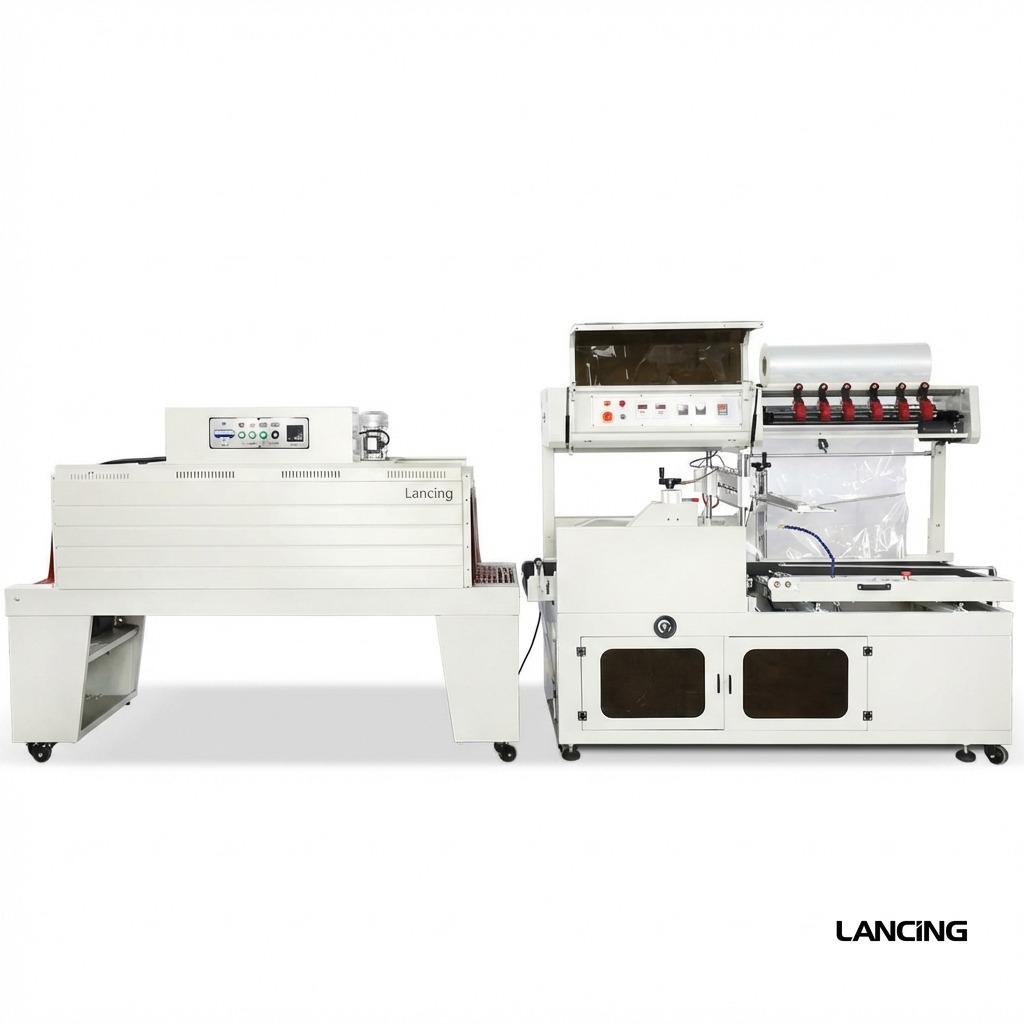
The LU-SPL6 route combines automatic sealing and a heat shrink tunnel. It automatically feeds shrink film, forms the seal around the product and transfers the pack through the tunnel for a tight shrink finish.
This page presents the core specification in buyer-friendly form so a production team can decide whether to request a detailed quotation or ask for an alternative shrink wrapping route.
Listed specification
Final configuration should be confirmed against your actual products and site conditions.
| Model | LU-BF750 / LU-SPL6 route |
|---|---|
| Power supply voltage | 220V 50–60Hz |
| Voltage | 380V 50/60Hz |
| Air pressure | 0.5Mpa |
| Power | 2.26kW |
| Packaging speed | 15–30 bag/min |
| Cutter size | 870mm × 770mm |
| Maximum package size | W+H ≤ 700mm, L+H ≤ 800mm, H ≤ 150mm |
| Conveyor belt width | 600mm |
| Applicable shrink film | POF / PE |
| Machine weight | 440kg |
| Transporting velocity | 0–15m/min |
Machine gallery
Project fit
Shortlist this configuration where the product range is reasonably defined, the finish of the shrink pack matters, and the target speed justifies a more automatic route than manual sealing.
FAQs
The listed output is 15–30 bag/min. Final throughput depends on product dimensions, pack format, film, changeover and line setup.
The listed applicable shrink film is POF / PE.
Send product dimensions, target throughput, film type, pack finish requirement, available space and utilities so suitability can be checked.
LU-SPL6 verification notes
The LU-SPL6 information on this site gives a useful starting point for an automatic L-sealer and heat tunnel route. The listed packaging speed of 15–30 bag/min, POF / PE film compatibility and maximum pack-size notes should be checked against the actual product, film and operator or conveyor conditions before purchase.
A sample review should confirm whether the product stays square through the infeed, whether the sealing position leaves an acceptable film allowance, whether the tunnel removes wrinkles without overheating the pack, and whether the pack is cool enough at discharge for handling or case packing.
| Selection point | What to confirm | Why it matters |
|---|---|---|
| Listed speed | 15–30 bag/min is shown for the route. | Treat this as product and film dependent; verify with pack dimensions, infeed and tunnel settings. |
| Film compatibility | POF / PE film is listed. | Film thickness, centre-fold width and perforation still need confirming for each product. |
| Maximum package size | W+H ≤ 700mm, L+H ≤ 800mm, H ≤ 150mm is listed. | Use the largest real pack tolerance when checking suitability. |
| Finished-pack quality | Check seals, wrinkles, dog-ears, film clouding and barcode visibility. | Commercial acceptability depends on the finished pack, not only machine fit. |
Confirm centre-fold width from the largest pack size and film allowance.
Plan seal-wire condition checks as part of routine maintenance.
Prepare the pack and production details needed for Lancing to quote accurately.
No. Suitability depends on carton size, stability, film type, tunnel finish and the required output.
Pack dimensions, feed consistency, film thickness, sealing dwell, tunnel dwell and cooling all affect real output.
POF / PE film compatibility is listed, but each film should be checked for thickness, centre-fold width and shrink behaviour.
Warm film can mark, loosen or distort if handled immediately, so discharge and downstream handling should be considered.
Product samples, dimensions, film details, photos, pack finish requirements and target output are the best starting evidence.
Related guidance: Automatic L sealer machines · Sample testing · Troubleshooting
LU-SPL6 validation
The LU-SPL6 is the model-level route, so application limits should be checked against the actual pack and film rather than assumed from a headline figure. The listed operating range should be reviewed against the product and film being tested. A short, stable carton may run differently from a taller, lightweight or irregular product, even when both are technically inside the same broad shrink wrapping category.
| LU-SPL6 check | What to verify | Acceptance evidence |
|---|---|---|
| Product envelope | Compare the product width, length and height with the listed package-size conditions already shown on this page. | Largest pack clears the sealing area and tunnel without forcing or bridging. |
| Film behaviour | Test the proposed POF or PE film at realistic temperature, dwell and conveyor settings. | Seal is closed, film is not scorched and the corners shrink acceptably. |
| Output target | Confirm the required pack rate with operator feed, infeed spacing and tunnel speed included. | Saleable packs are produced at the required speed, not only mechanically cycled. |
| Finished presentation | Check label visibility, barcode visibility, air release and whether the wrap is protective or display-quality. | Finished samples match the buyer’s retail or transit requirement. |
The video supplied with the site can help a buyer understand the process route, but it should not be treated as proof that every product will run at the same output or finish. Suitability still needs sample packs, film details and layout information.
Support pages: sample testing · seal wire replacement · troubleshooting · specification checklist
LU-SPL6 application evidence
The LU-SPL6 information is strongest when it is tied to the product and film conditions. Output, pack quality and heat tunnel finish depend on product envelope, operator or conveyor feed, film specification and settings. The stated range should therefore be treated as application-dependent rather than universal.
Before ordering, Lancing should review sample dimensions, photos, film type, required finish, site utilities and acceptance criteria. Where possible, a sample pack or video review helps identify seal position, trapped air, distortion and cooling issues before the machine is installed.
| Point to confirm | What Lancing checks | Why it matters |
|---|---|---|
| Model fit | Pack width, length, height and stability against the stated machine envelope. | Prevents specifying a system around a product that is close to a limit. |
| Film fit | POF or PE film route, film thickness, centre-fold width and perforation need. | Affects sealing dwell, tunnel recovery and pack presentation. |
| Utility fit | Available power, compressed air where required, access and machine footprint. | Confirms practical installation before shipment or commissioning. |
| Acceptance fit | Good-pack standard, sample photos and reject examples. | Creates a practical benchmark for FAT, SAT and operator sign-off. |
Define test packs and acceptance evidence for LU-SPL6 projects.
Use video and samples to qualify shrink quality.
Agree finished-pack standards before production.
No. Output depends on product size, film behaviour, operator or conveyor feed and the finished-pack quality required.
The route is presented for POF and PE film applications, but suitability should be confirmed against the exact film and product.
Pack quality, seal position, tunnel finish, cooling, repeatability, safety guarding, operator access and basic maintenance points should be checked.
Useful next step: Send product dimensions, photos, film details and target output through the existing enquiry form so Lancing can check the L-sealer route before quotation.
LU-SPL6 evidence
The LU-SPL6 figures on this page are useful screening information. A project decision still needs product-specific evidence showing that the pack can be detected, sealed, transferred, shrunk and cooled under the intended production conditions.
Direct answer: A LU-SPL6 trial should prove repeatable product detection, film tracking, seal continuity, tunnel finish, discharge stability and acceptable product condition.
The trial should include the difficult products, not only the easiest carton. It should also record the film used, spacing method, relevant settings and good-pack criteria so the result can be understood and repeated.
Direct answer: The listed envelope is a screening limit, not a guarantee that every shape within it will run or produce the required finish.
Real clearance is affected by pack orientation, height, protrusions, film movement and the route through the sealing and tunnel sections. The largest product should be shown on a drawing and checked with the intended film before approval.
Direct answer: The project should confirm the electrical supply, compressed-air requirement where applicable, access, floor space, conveyor interface and safe working area stated in the final quotation and machine documentation.
Utility assumptions should not be taken from a generic product page alone. Site conditions, isolators, cable routes, ventilation, floor loading and upstream or downstream equipment may change the installation plan.
Direct answer: Testing should include the largest, smallest, lightest, heaviest and least stable packs that the machine is expected to run.
Where products vary in surface coating, temperature, sharpness, barcode position or internal movement, those differences should also be represented. A narrow sample set can approve a setting that does not reflect the real production range.
Related guidance: Sample pack video review · FAT/SAT checklist · Quotation comparison
LU-SPL6 confirmation
Direct answer: The LU-SPL6 route should be confirmed against the real product, film and site conditions before purchase. The listed 15–30 bag/min range and POF/PE film compatibility are useful shortlist data, but final suitability depends on pack size, film thickness, sealing response, tunnel recovery, cooling and line handling.
| LU-SPL6 item | Confirmation required | Reason |
|---|---|---|
| Pack size | Largest and least stable products, including presentation face and tolerance. | Protects against specifying around only the easiest sample. |
| Film | POF or PE grade, centre-fold width, thickness, perforation and roll handling. | Controls seal location, tunnel recovery and finished appearance. |
| Output | Target packs per minute and whether the feed is manual, conveyor or upstream equipment. | Practical output depends on stable presentation and spacing. |
| Site | Utilities, floor space, access, heat management and discharge handling. | Determines whether the machine can be operated, maintained and cooled correctly. |
Related guidance: Film and seal-window testing · Site preparation · Controls integration
LU-SPL6 checks
Direct answer: The LU-SPL6 route should be reviewed against real product size, film type, air evacuation, seal method, tunnel recovery and site access. The listed speed and film compatibility are useful starting points, but final suitability depends on samples, layout and the finished-pack standard.
Related guidance: seal method · air evacuation · cooling and distortion